Custom Photography Website vs Template: Which One Actually Converts?
A frank comparison of custom photography websites vs. template builders; what each delivers, what each costs in the long run, and what actually makes a photography website more likely to turn visitors into inquiries.

TLDR
Templates are fast and affordable. Custom websites are built around a specific business, client, offer, and conversion path.
If your goal is simply to get a photography portfolio online, a template can do the job.
But if you want your website to actively help you attract the right clients, build trust, communicate your value, and move visitors toward an inquiry, the difference is not the template itself. It’s the strategy behind the website.
Here is exactly what changes when you move from a generic template to a website built around your business.
When it is time to build your photography website, two paths sit in front of you.
You can spend a few hundred dollars on a Squarespace, Showit, Wix, or similar template and launch relatively quickly.
Or you can invest in a custom website built specifically around your photography business, with projects ranging from $2,500 to $8,500 depending on the level of strategy, functionality, and support required.
The gap in upfront cost is obvious.
The difference in what the website is designed to accomplish is less obvious.
This article breaks down both options honestly; what you get with each, what you give up, when a template makes sense, and what actually makes a website more effective at generating inquiries.
What Is a Template Photography Website?
A template is a pre-designed website layout that you customize with your own photos, colors, branding, and text.
Platforms such as Squarespace, Showit, Wix, and Format offer templates designed specifically for photographers.
The appeal is obvious.
They are relatively affordable. They are fast to launch. And many of them look excellent straight out of the box.
If you need a professional-looking online presence quickly, a good template can be a perfectly reasonable choice.
But there is a limitation.
The template wasn’t designed around your ideal client, your offer, your positioning, or your sales process.
The structure was created to accommodate a broad range of businesses.
That means the photographer has to make the template fit the business rather than having the website built around the business.
And that distinction matters when your goal is more than simply displaying your work.
What Is a Custom Photography Website?
A custom website is built around your specific business: your ideal clients, your photography niche, your brand, your offer, and your market.
It does not start with a layout.
It starts with strategy.
Who are you trying to reach?
What does that client care about?
What are they worried about before hiring you?
What do they need to understand before they are comfortable reaching out?
What makes your offer different?
What path should a visitor take from the homepage to the inquiry form?
Once those questions are answered, the design, copy, structure, calls to action, and technical setup can be built around those decisions.
That is the fundamental difference.
A template starts with the website. A custom website starts with the business and the client.
The Metric That Matters Most: Inquiry Rate
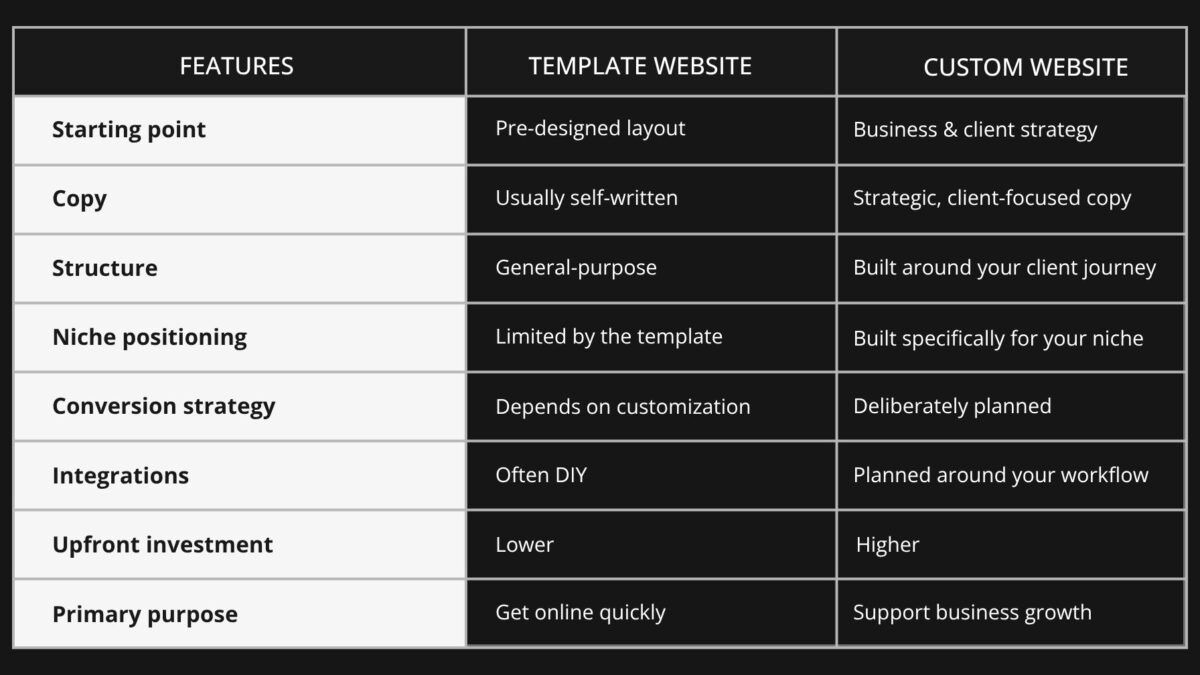
The point isn’t that every custom website will automatically outperform every template. A well-built template can work extremely well. The difference is that a custom website gives you much more control over how the entire experience is structured around your specific client and business.
There is one number photographers should pay much more attention to than how beautiful their website looks:
How many qualified visitors actually become inquiries?
Your website’s job isn’t simply to receive traffic.
It needs to help the right visitor understand:
- Who you are
- Who you serve
- What you offer
- Why they should trust you
- What makes you different
- What they should do next
There is no universal conversion rate that every photography website should achieve.
Traffic quality, niche, offer, pricing, location, reputation, seasonality, and the source of the traffic all affect how many visitors become inquiries.
So instead of promising that a custom website automatically converts at a specific percentage, look at the underlying principle.
If two photographers receive similar-quality traffic, the website that communicates more clearly, builds more trust, removes more friction, and provides a stronger path to inquiry has a better opportunity to generate results.
For example, imagine a photographer receives 500 relevant website visitors in a month.
If 1% become inquiries, that’s 5 inquiries.
If improvements to the website, offer, messaging, traffic quality, and conversion path eventually increase that to 3%, that’s 15 inquiries.
That’s 10 additional opportunities from the same amount of traffic.
The important point isn’t that every photographer should achieve 3%.
The point is that conversion is something your website should be designed and measured around — not something you should leave to chance.
And even before you start optimizing conversion rate, you need to know what is happening.
How many people are visiting?
Where are they coming from?
Which pages do they view?
Where do they leave?
How many reach your contact page?
How many actually submit an inquiry?
Without that information, your website is operating largely in the dark.
5 Ways a Custom Website Can Outperform a Template
1. Copy Written Specifically for Your Clients
Template websites often come with generic language such as:
“Welcome to my photography studio.”
The photographer then replaces it with another version of the same generic message.
The problem isn’t the template’s words.
The problem is that the copy hasn’t been written around a specific client.
A strategic website starts with the person you’re trying to reach.
What are they looking for?
What are they afraid of?
What questions are they asking?
What do they need to believe before they trust you?
The copy should answer those questions throughout the website.
Instead of simply saying:
“I’m a wedding photographer who captures authentic moments.”
you might build the messaging around what the client actually cares about:
“You only get one wedding day. Your photos should let you relive it without feeling like you spent the day posing for a camera.”
The second message is more specific because it starts with the client’s experience.
That’s the kind of thinking that should influence the copy across the entire website.
2. Structure That Follows Client Psychology
A template’s layout is primarily a starting point.
A strategic website asks a different question:
What does this visitor need to see next?
A potential client arriving at your website cold needs clarity before they are ready to inquire.
They need to understand who you serve and what you offer.
Then they need reasons to trust you.
Then they need enough information to evaluate whether you’re right for them.
Then they need an obvious next step.
A useful conversion structure might look something like:
Hook → Trust → Clarity → Action
The homepage should introduce the right client to the right outcome.
Trust elements should reduce uncertainty.
Services and pricing should create clarity.
And the call to action should make taking the next step easy.
That’s very different from simply arranging sections because they look good together.
3. It Can Create Stronger Differentiation
Photography is a visual business.
That means photographers often put enormous effort into making their images stand out.
But the website surrounding those images matters too.
If a potential client is comparing several photographers who all have beautiful galleries, another beautiful gallery may not be enough to distinguish one business from another.
Your positioning, messaging, visual identity, structure, client experience, and offer all contribute to how the business is perceived.
A custom website gives you more control over that entire experience.
The goal isn’t to make the website look different simply for the sake of looking different.
The goal is to make the website feel intentional and specific to the photographer it represents.
4. Built for Your Specific Niche
A wedding photographer and a commercial photographer don’t have the same sales process.
Neither does a portrait photographer, newborn photographer, or brand photographer.
Their clients have different questions.
They have different concerns.
They evaluate different things before making a decision.
A custom website can be structured around those differences.
A wedding photographer might need to communicate the experience of working together, availability, investment, approach to the wedding day, testimonials, and what happens after inquiry.
A commercial photographer may need to communicate production capabilities, previous campaigns, licensing, turnaround times, client types, and professional credentials.
The website should reflect the decision the client is actually trying to make.
Specificity is one of the biggest advantages of custom work.
5. Backend Integration Done Right
A website doesn’t stop working when someone clicks “Submit.”
That’s when another part of the system begins.
What happens after someone submits an inquiry?
Do they receive confirmation?
Do they know what happens next?
Can they schedule a call?
Does the inquiry reach the right system?
Can you track the lead?
Can you follow up with people who aren’t ready to book immediately?
Your website can be connected to tools such as your CRM, booking system, email platform, analytics, and advertising infrastructure so the frontend experience and backend process work together.
At Focus Point Studio, this is part of the larger philosophy behind the service: the website isn’t treated as an isolated design project. It’s built as part of a complete system that helps attract, convert, and manage potential clients.
When a Template Actually Makes Sense
Templates are not the enemy.
In fact, there are situations where a template is exactly what a photographer needs.
If you’re just starting out, have limited funds, don’t have much of a portfolio yet, and simply need a professional online presence, a template can be a smart choice.
You don’t necessarily need to spend thousands of dollars on a website before you’ve established the business.
A template can help you get online, start marketing yourself, collect inquiries, and build your portfolio.
The important thing is knowing when you’ve outgrown it.
If you’re already established but your website feels generic, attracts the wrong type of inquiry, doesn’t communicate your value, or gives visitors no clear path toward booking, that’s when the conversation changes.
At that point, the question isn’t:
“Can I make this template look better?”
It’s:
“Is this website actually supporting the business I want to build?”
The Real Total Cost of Ownership
Most photographers compare a template and a custom website by looking only at the upfront price.
For example:
Template
- Initial template purchase or setup
- Platform subscription
- Your time customizing the site
- Your time maintaining it
- Additional tools and integrations
- Potential opportunity cost if the site fails to communicate your value
Custom website
- Strategic planning
- Custom design
- Strategic copywriting
- Conversion-focused structure
- Technical setup
- Backend integrations
- Professional implementation
The real comparison isn’t simply:
“$300 versus $2,500.”
It’s:
“What am I investing in, and what is this website supposed to do for my business?”
If the website is simply an online portfolio, a template may be enough.
If the website is expected to become an important part of your sales system, the requirements are different.
What Focus Point Studio Builds
At Focus Point Studio, custom photography websites start at $2,500, with Signature projects at $5,000 and Premium engagements at $8,500. Every website is built around the photographer’s brand, ideal client, offer, and sales process; not adapted from a template.
Not templates with your logo placed on top.
Not recycled layouts with generic copy.
We build each website around the photographer’s brand, ideal client, offer, and sales process.
Our approach combines:
- Custom design built around your brand and visual identity
- Strategic copywriting written around your ideal client’s needs
- Conversion architecture that gives visitors a clear path toward your offer
- Backend integration connecting your CRM, booking system, and email platform
- A complete website system designed to work while you’re busy shooting, editing, and running your business
Our Starter website begins at $2,500 and is designed as a 4–6 page custom website engagement.
The goal isn’t simply to give you a better-looking website.
It’s to build a website that works as hard as you do.
Conclusion
Templates are a perfectly valid place to start.
But there is a difference between having a website and having a website that has been deliberately built around your business.
A template gives you a starting structure.
A custom website gives you the opportunity to build the structure around the people you actually want to attract.
That means clearer messaging.
Better positioning.
A more intentional client journey.
Stronger trust-building.
A clearer path to inquiry.
And a backend that can support what happens after someone raises their hand.
The question isn’t whether a custom website automatically converts better.
It doesn’t.
A poorly planned custom website can perform worse than a well-built template.
The real advantage is that a custom website can be deliberately designed around your client, your offer, your positioning, and your conversion process rather than forcing your business into a structure designed for everyone.
That’s the difference.
A website that looks good gets attention.
A website built around your client gives that attention somewhere to go.
Ready to build a website around your photography business?
Book a free 20-minute website review
No pitch. We’ll look at your current website, identify what could be improved, and show you what we’d change and why. This aligns with the free-review positioning already established in your Photography Website Checklist.